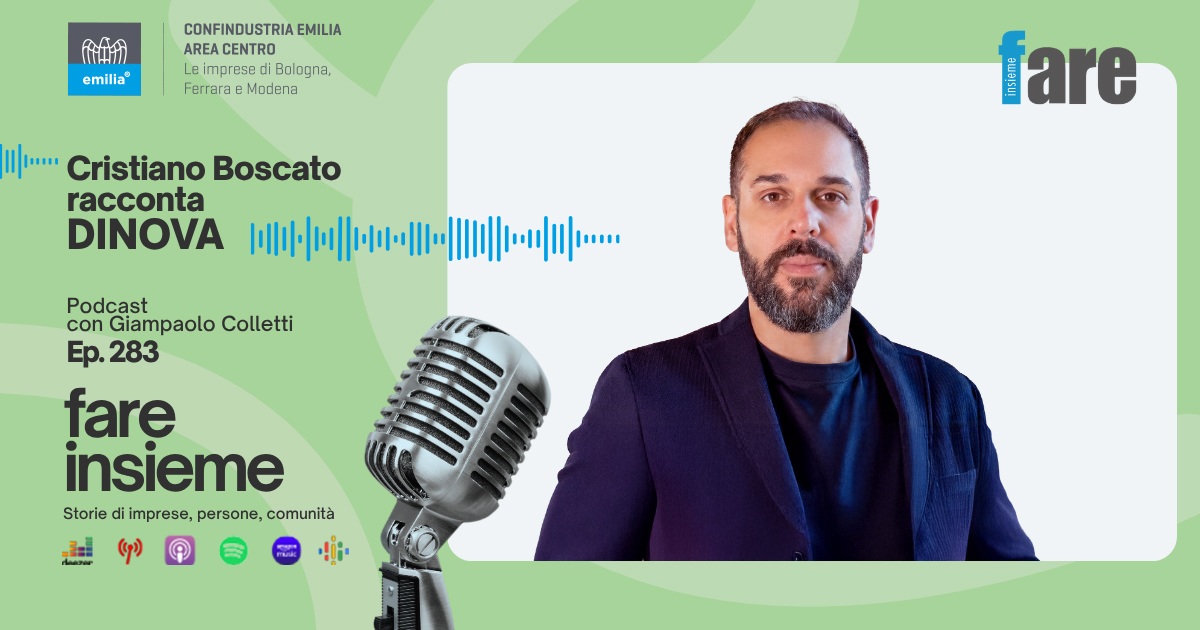
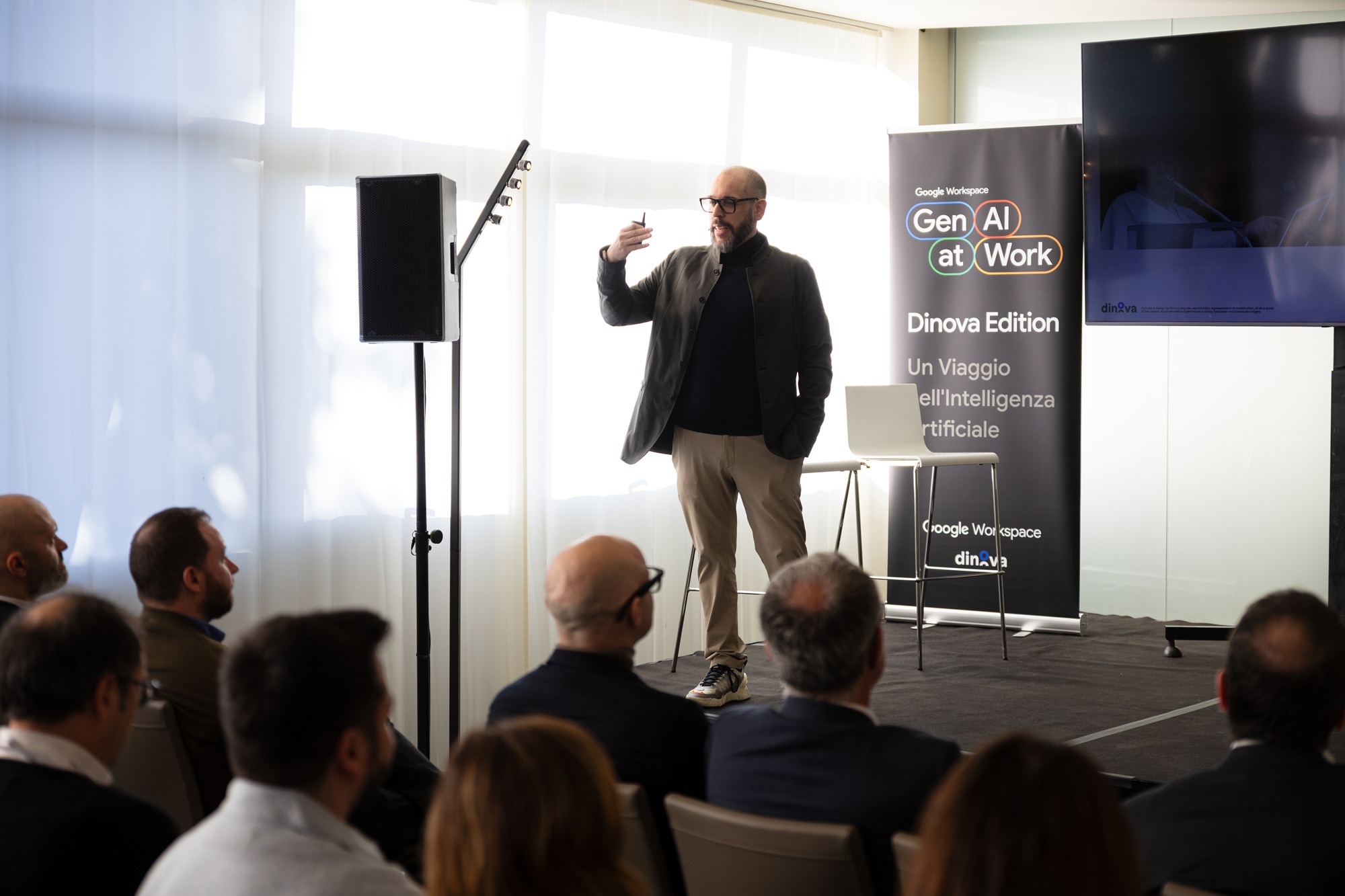
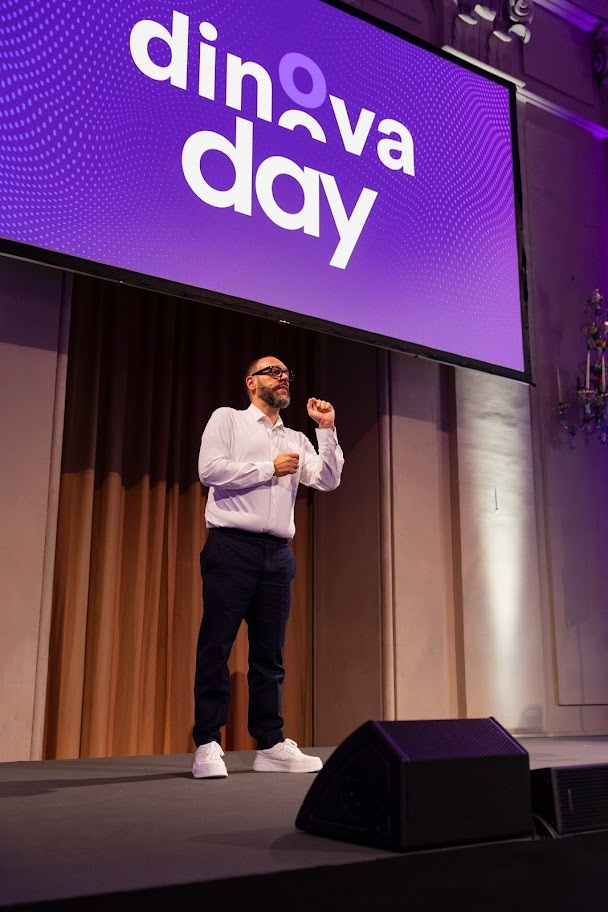
In Emilia, a tech business builds value by putting skills, innovation and vision at the centre. Dinova supports companies on their digital innovation journey by integrating human and technological capital. It is a model that looks to international scalability and the growth of organisations, because true innovation occurs when people steer technology. For FARE INSIEME, Giampaolo Colletti interviewed Cristiano Boscato, CEO of Dinova
by Giampaolo Colletti
@gpcolletti
There are companies that stem from a technological leap and others that stem from a systemic vision. Then there are those that combine both elements - a brilliant intuition and the building of a meaning over time. This is a story that illustrates how human and technological capital can intertwine to become a single driver for growth. We find ourselves in the heart of Emilia, one of the most dynamic industrial districts in Europe. Here, digital innovation becomes an actual journey that crosses companies, supply chains and international markets, and this is where Dinova was born, a company that, over the years, has built a model capable of combining advanced skills, technological innovation and a strategic vision. The company forms part of Gruppo Maggioli and has its headquarters in Bologna with branches in Milan and Rome. It employs around 350 people serving over two thousand companies with the objective of turning technology into actual value not just with IT solutions, but with digital architectures capable of supporting organisations in their evolution. “Technology alone is not enough. The true competitive factor is the ability of combining different skills to turn them into a shared project,” explains Cristiano Boscato, CEO of Dinova and previously founder and leader of various top companies dealing with innovation, and named by Forbes as one of the Top 100 Italian Managers boasting a degree in Semiotics and a past as a student of Umberto Eco. In a sector where the speed of innovation often risks putting people second, the company overhauls the system and does exactly the opposite. The vision speaks of an ecosystem where the improvement of people stimulates the evolution of organisations, meaning the human factor is quite relevant at a time dominated by artificial intelligence. “We aim to be a technological and business enabler, but also a social and cultural one to help organisations deal with present and future challenges,” stresses Boscato.
Company profile. Of course technology remains one of the pillars. After all, the company works with digital transformation to support companies in the evolution of their IT systems, data management and in the development of advanced digital platforms. This work requires the ability to integrate complex systems, knowledge of technological architecture and a vision increasingly oriented towards scalability. “Nowadays companies do not require technology alone, but solutions that can grow with them, adapt to market changes and support international expansion.” And the international dimension is precisely one of the fields in which the company is investing the most. In an economy that is increasingly interconnected, the ability to operate in global markets is no longer an option, but rather a necessary condition to grow. That is why a flexible organisational model focused on collaboration and capable of integrating internal skills and high-level technological partnerships was born. To be agile as a start-up and solid as an organisation. This balance also encloses the DNA of a business that tackles complex projects and supports companies on their digital transformation journey. All this involves rethinking processes, models and skills. What is more, it means mostly creating an ongoing dialogue between technology and business. “This challenge concerns first and foremost the way in which organisations evolve over time,” says Boscato.
The power of expertise. Another element that may seem paradoxical and actually entails a winning idea is digital innovation that puts people at the centre. It is an ambitious challenge, yet a necessary one to set up a professional community where technical skills, consulting abilities and a strategic vision coexist. “Skills are the true assets of a technological business. They help interpret change and turn it into concrete solutions for clients,” repeats Boscato as a mantra. The DNA of this company illustrates all this, starting from a new model of an Italian technological company: deep roots in the territory and a capability of entering into a dialogue with international markets and partners. If we look to the future, the direction is clear, i.e. to continue investing in people and in the ability of developing scalable technological solutions. “Actual innovation occurs when human and technological capital work together. That is where value is built over time,” concludes Boscato. And this is maybe the distinctive trait of the Dinova story. Not technology in itself, but the ability to turn it into growth. In a territory where industries have always been able to reinvent themselves, digital innovation becomes just the new chapter of a book that builds towards the future starting from the present - step by step, together.
https://podcast.confindustriaemilia.it/
Read the other interviews