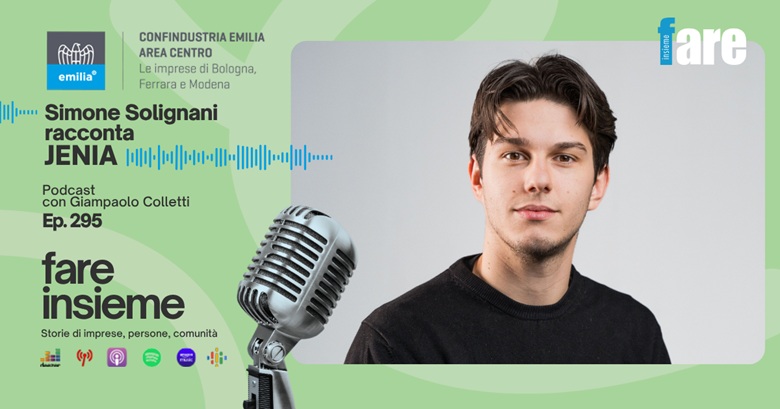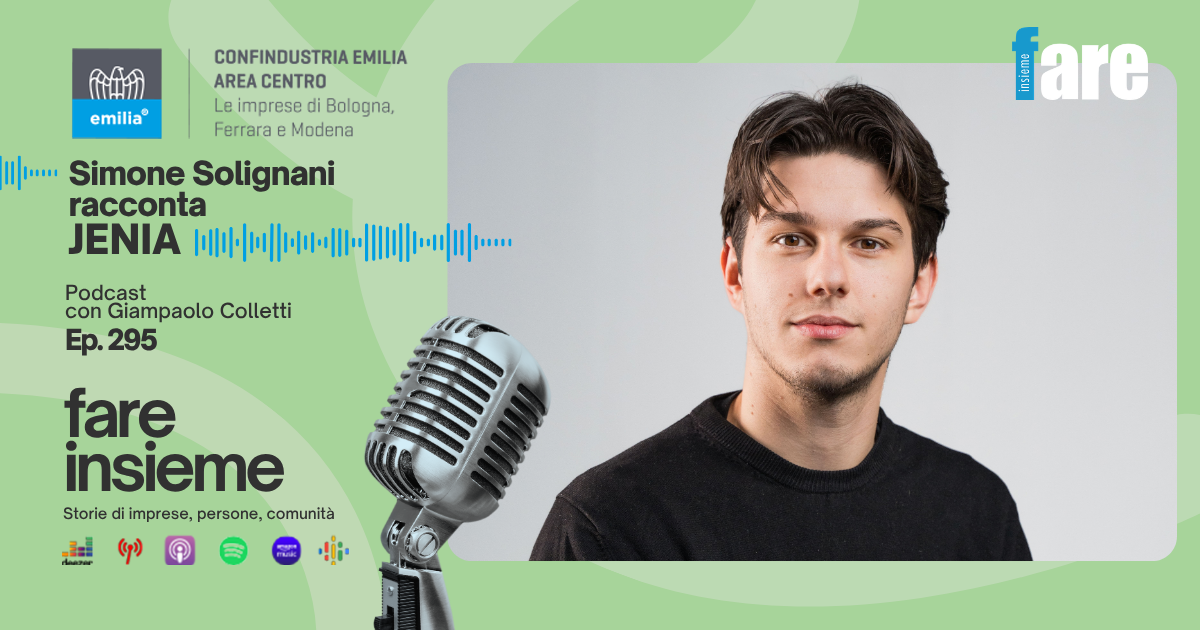
In Sassuolo, a startup founded by a 22-year-old is turning artificial intelligence into a digital colleague that frees up people’s time. The story of Jenia shows that innovation does not begin with algorithms, but with listening to businesses. For FARE INSIEME, Giampaolo Colletti interviews Simone Solignani, co-founder and CEO of Jenia.
by Giampaolo Colletti
@gpcolletti
While artificial intelligence promises to change the world, Simone Solignani chose to start from something much more concrete: entering an order. It was in that repetitive daily task, one that absorbs time, energy and attention, that he found the starting point for his business. Before building an AI agent, he did something that few people do today: he listened. “We visited around one hundred companies and asked them the same question every time: where are you wasting time? Where are the bottlenecks?” The answer was almost always the same. Data scattered across management systems, Excel spreadsheets and shared folders. Information that was difficult to find. Manual tasks that forced people to connect systems that could not communicate with one another. That was how Jenia was born: a Sassuolo-based startup specialising in the development of AI agents for small and medium-sized businesses. A short, feminine name with an immediate sound, inspired by the word “genìa”, but also reflecting a new generation of companies: those built around artificial intelligence from the outset. Behind this project is the story of an entrepreneur who fully belongs to Generation Z. Simone Solignani was born in 2003 in Marano sul Panaro, grew up in Vignola and attended scientific secondary school. While his peers were discovering social media, he spent his days studying algorithms and mathematical systems applied to financial markets. At sixteen, he developed models to exploit betting platform promotions through risk-hedging techniques. What began as an exercise in data analysis soon became something much bigger. At eighteen, he founded his first company. Within two years, together with his business partner, he came close to reaching €1 million in turnover. A second startup followed, focused on software development. At that time, artificial intelligence was still a field explored by relatively few specialists. For him, it was already the future.
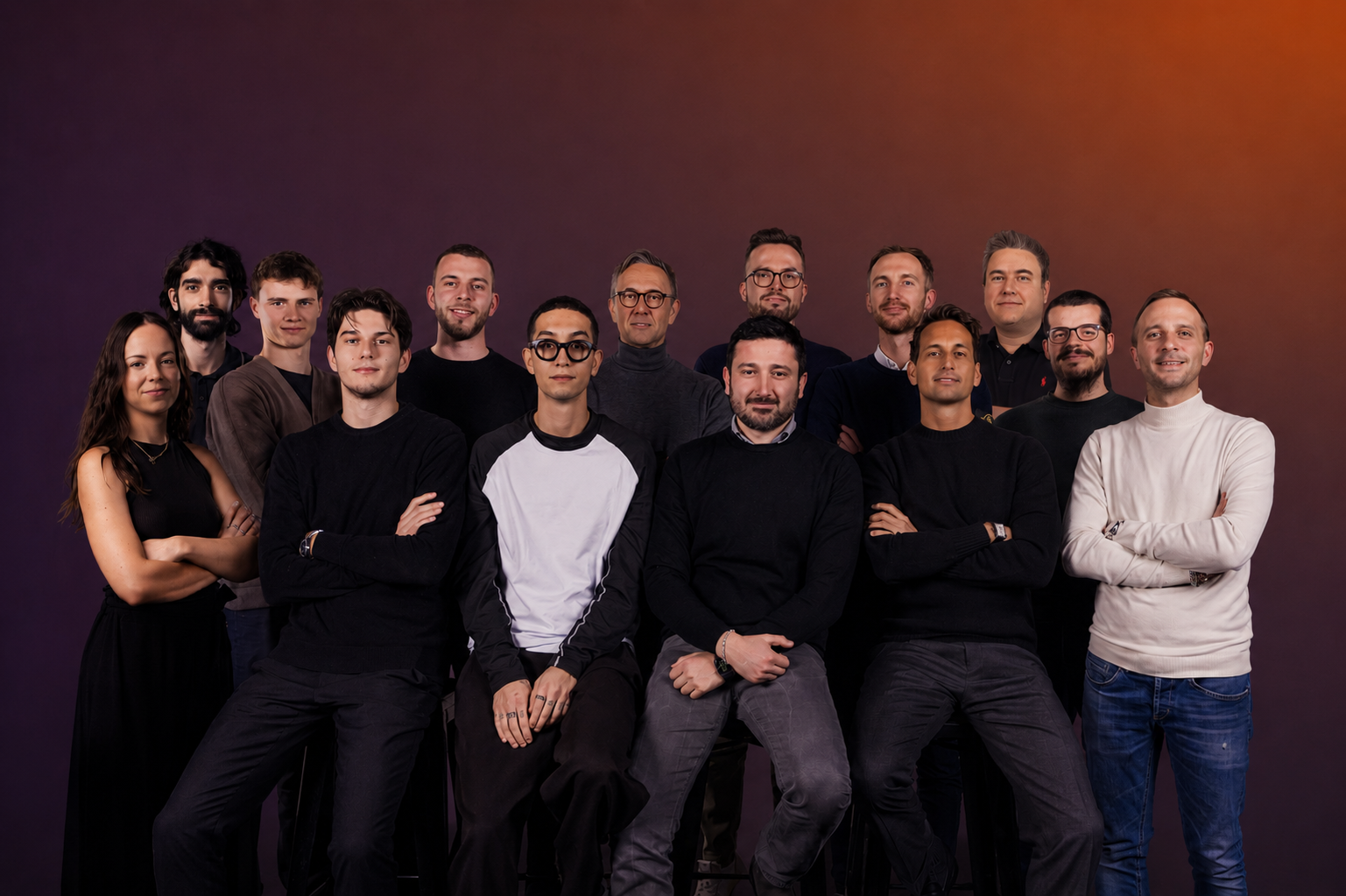
Start-up profile. The idea for Jenia also came from observing his parents’ businesses up close. They ran two small companies: a bed and breakfast and a metalworking company. Two different worlds, but with the same challenge: large amounts of time spent on operational tasks that created little value. Today, Jenia is the result of the combination of a startup specialising in data analytics and a a company focused on communication and marketing. Its operational headquarters are in Sassuolo, at the heart of one of Europe’s most important manufacturing districts. The team consists of ten professionals and aims to grow to fifteen people by the end of the year. It mainly works with SMEs in Emilia-Romagna, Veneto and Tuscany, helping businesses in ceramics, marble, manufacturing and B2B services design tailor-made AI agents. For Solignani, however, the goal is not to develop yet another chatbot. “An artificial intelligence tool answers a question. An AI agent works. It understands the company context, communicates with management systems, gathers information, carries out tasks and completes processes”, says Solignani. The difference is fundamental. That is why every project begins with a discovery phase. Before technology comes the need to understand how an organisation actually works. “Technology without an understanding of the process is of little use. We do not start with the algorithm. We start with people”, explains Solignani.
The mission. The approach is deeply rooted in Emilia-Romagna. Practical. Measurable. No futuristic promises, but tangible results. “Entrepreneurs do not buy artificial intelligence here. They buy time and, ultimately, fewer mistakes. They buy better data,” says Solignani. Jenia’s work consists of adding a layer of intelligence on top of existing systems. ERP, CRM and management software are not replaced; they are finally connected. This allows ten years of company information, previously difficult to access and use, to become available through natural language. A single question, just like in a chat, can provide answers in seconds that once required lengthy manual searches. This is where artificial intelligence truly changes the way people work. It does not remove value from people; it removes the repetitive part of their work. The AI agent handles mechanical tasks, while people can focus on decisions, relationships and creativity. Looking ahead, Solignani imagines factories where data, people and digital agents work together naturally. Not companies controlled by machines, but organisations where everyone can focus on what they do best. And what if the future was not about building increasingly intelligent computers, but about giving intelligence back to people’s time?
https://podcast.confindustriaemilia.it/
Read the other interviews